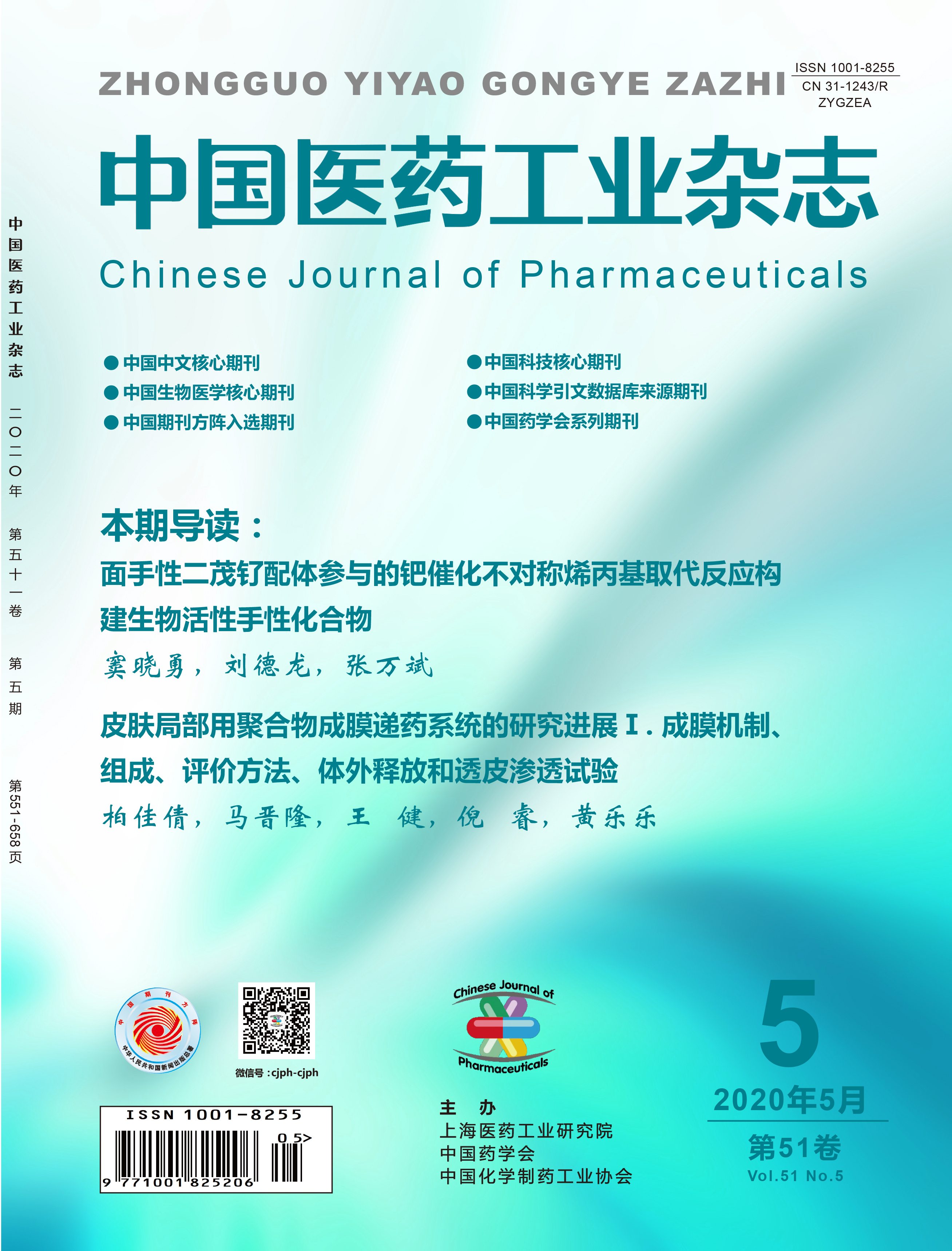
主办:上海医药工业研究院
   中国药学会
   中国化学制药工业协会
ISSN 1001-8255   CN 31-1243/R   ZYGZEA

Archive

  • Select all
    |
    Perspectives & Review
  • Perspectives & Review
    DOU Xiaoyong, LIU Delong, ZHANG Wanbin
    Abstract ( ) Download PDF ( )   Knowledge map   Save
    The synthesis and application of chiral ferrocene ligands have developed rapidly, some of which have been used in industrialization. As the analogs of ferrocenyl ligands, however, chiral ruthenocenes have received much less attention. The distance between the two cyclopentadienyl rings in ferrocene and ruthenocene is expected to present different electronic and steric effects compared with those exhibited by ferrocene ligands, resulting in inconsistent complexation properties and catalytic behaviors. This review introduces three types of planar chiral ligands derived from ruthenocenyl monoacid or diacid. First, the synthesis and application of a non-C2-symmetric 1,2-disubstituted ruthenocene-based P,N-ligand(mono-RuPHOX) derived from monoic acid are introduced. Then, C2-symmetric bisphosphine-bisoxazoline ligands(RuPHOX) derived from ruthenocenyl diacid are summarized. Finally, based on the synthesis of RuPHOX, planar chiral ruthenocene bisphosphine ligands are also discussed. These ligands have been applied to Pd-catalyzed asymmetric allylic substitutions, showing excellent reactivity and stereoselectivity for the construction of a series of chiral compounds with biological activities. Furthermore, these ligands are more air-stable than the corresponding ferrocene ligands. From the results of the single crystal X-ray analysis and the asymmetric catalytic behaviors, it could be seen that the twist angle of the two Cp rings in the Pd-complexes of the planar diphosphine ligands has an obvious effect on enantioselectivity. The relationship between the twist angle and the asymmetric catalytic behavior will assist us in the development of excellent chiral ligands.
  • Perspectives & Review
    BAI Jiaqian, MA Jinlong, WANG Jian, NI Rui, HUANG Lele
    Abstract ( ) Download PDF ( )   Knowledge map   Save
    Skin diseases have plagued the lives of people, but the conventional products for topical skin treatment have various limitations like short retention time, high-frequency administration and poor patient compliance. Polymeric film-forming system(FFS) is one of the novel topical delivery systems, which is applied to the skin in solutions or semisolid dosage forms, forming transparent in-situ film with the solvent evaporating. The formed film acts as a reservoir for drugs, in which drugs can continuously penetrate into skin, and exerts a long-acting effect. Moreover, polymeric FFS is beneficial to reduce the administration frequency and improve patient compliance, showing a huge potential for skin topical preparation. This review mainly introduces the film-forming mechanism and compositions of polymeric FFS, and summarizes the in vitro methods for evaluating the characteristics of the formed film and drug release and transdermal penetration behaviors.
  • Perspectives & Review
    JIN Jieyu, WANG Dandan, GAO Qi
    Abstract ( ) Download PDF ( )   Knowledge map   Save
    Polypentenols from Folium Ginkgo have a variety of potential pharmacological effects, such as antiviral, antibacterial and anticancer activities, and the related research at home and abroad has made a certain progress. The extraction, separation and purification methods for polypentenols from Folium Ginkgo are briefly introduced and compared. The determination methods for polypentenols are also outlined. Additionally, the resource reuse scheme for polypentenols from waste residues of Folium Ginkgo is mentioned in order to provide a theoretical basis for making full use of Ginkgo biloba resources in China.
  • Paper
  • Paper
    ZHENG Yi, SUN Xiuling, GONG Xiaoshun, BAI Wenqin, ZHANG Guimin
    Abstract ( ) Download PDF ( )   Knowledge map   Save
    The synthetic process of sacubitril calcium(1) was improved. (2R)-1-[(1,1'-Biphenyl)-4-yl]-3- hydroxypropane-2-yl-carbamate tert-butyl ester(2) was oxidized to (2R)-1-[(1,1'-biphenyl)-4-yl]-3-oxopropane-2-ylcarbamate tert-butyl ester(3) with pyridinium chlorochromate loaded on silica(PCC/SiO2) as solid oxidant. PCC/SiO2 was removed from reaction solution and then the filtrate was reacted with (carbethoxyethylidene)triphenylphosphorane to give (R,E)-5-[(1,1'-biphenyl)-4-yl]-4-[(tert-butoxycarbonyl)amino]-2-methyl-2-pentenoic acid ethyl ester(4) via Wittig reaction. Compound 4 was hydrolyzed with lithium hydroxide, and triphenyl phosphorus oxide was adsorbed by activated clay and its content in (R,E)-5-[(1,1'-biphenyl)-4-yl]-4-[(tert-butoxycarbonyl)amino]-2-methyl-2-pentenoic acid(5) was less than 0.01%. Sacubitril calcium(1) was prepared via chiral hydrogenation reduction, acetylation, amidation and salt formation from 5, with a purity of 99.91% and a total yield of 60%(based on 2). This improved process was easy to operate, and only recrystallization of 5 was needed, which was suitable for industrial production.
  • Paper
    WANG Haibo, LIU Ge, TI Wenli, CHU Yanjun, ZHANG Guimin
    Abstract ( ) Download PDF ( )   Knowledge map   Save
    The synthetic process of ramipril(1) was improved in this report. Benzyl (2S,3aS,6aS)- octahydrocyclopenta[b]pyrrole-2-carboxylate hydrochloride(2) was condensed with N-[1-(S)-ethoxycarbonyl-3-phenyl propyl]-L-alanine(3) in the presence of 1-(3-dimethylaminopropyl)-3- ethylcarbodiimide hydrochloride(EDC·HCl)and 1-hydroxybenzotriazole(HOBt) to give benzyl (2S,3aS,6aS)-1-[(2S)-2-[[(1S)-1-ethoxycarbonyl-3-phenyl propyl]- amino]propionyl]-octahydrocyclopenta[b]pyrrole-2-carboxylate(4), which was subjected to 10% Pd/C-catalyzed hydrogenation to obtain 1 in a total yield of 81% and a purity of 99.81%. In the condensation step, usage of water-soluble EDC·HCl instead of N,N'-dicyclohexylcarbodiimide(DCC) could have the following advantages: the hydrolysate of EDC was easy to remove, reaction time was shortened from 6 h to 2 h, and the purity of 4 was increased from 90% to 96%. In addition, the amount of 10% Pd/C used in hydrodebenzylation was reduced to 25% of the literature. This process was simple, time-saving, cost-effective, and more suitable for industrial production.

  • Paper
    FENG Weiwei, LIU Fei, XU Yungen, ZHANG Yinsheng
    Abstract ( ) Download PDF ( )   Knowledge map   Save
    Deudaclatasvir dihydrochloride(1b) is a HCV NS5A inhibitor developed independently by us, which has a better druggability. 4,4'-Bis[N-tert-butoxycarbonyl-(2S)-pyrrolidine-2-carbonyloxymethylformyl]-1,1'-biphenyl(4) was synthesized via esterification between 4,4'-bis(2-bromoacetyl)-1,1'-biphenyl(2) and N-tert-butoxycarbonyl-Lproline( 3). Then 4,4'-bis[2-[N-tert-butoxycarbonyl-(2S)-pyrrolidine-2-yl]-1H-imidazol-5-yl]-1,1'-biphenyl(5) was prepared by ammonolysis and cyclization of 4. Compound 5 was deprotected by hydrochloric acid to give 4,4'-bis[2- [(2S)-pyrrolidine-2-yl]-1H-imidazol-5-yl]-1,1'-biphenyl tetrahydrochloride(6), which was followed by condensation with N-[(methoxy-d3)carbonyl]-L-valine(8) and salt formation with HCl(g) to provide 1b with a purity of 99.66% and a total yield of 45%(based on 2). This process had the advantages of mild reaction conditions and simple operation, which was suitable for industrial production.
  • Paper
    QIU Wenmei, XU Xiaoli, CHEN Chunyan, MA Lirong, ZHAO Jianhong
    Abstract ( ) Download PDF ( )   Knowledge map   Save
    The synthetic process of hydroxychloroquine sulfate(1) was improved. 4,7-Dichloroquinoline(3) and 5-(N-ethyl-N-2-hydroxyethylamino)-2-pentylamine(4) were refluxed in n-butanol with potassium carbonate as the acid binding agent to give hydroxychloroquine(2). Sulfuric acid was directly added dropwise to the n-butanol solution of 2 to obtain 1 with a purity of 99.06% after recrystallization with EtOH. The improved process involved fewer steps and was easy to operate. Using n-butanol as a solvent would effectively avoid the loss of 3 due to sublimation, and using potassium carbonate as an acid-binding agent could decrease the formation of impurities 4-[2-(5-hydroxyethylamino)- pentyl]amino-7-chloroquinoline(5) and N-[2-[(7-chloroquinoline-4-yl)oxy]ethyl]-N-ethylpentane-1,4-diamine(6). The total yield increased from 39% to 69%(based on 3).
  • Paper
    Xinchang Pharmaceutical Factory Zhejiang Medicine Co., Ltd., Xinchang 312500
    Abstract ( ) Download PDF ( )   Knowledge map   Save
    Two related substances in ertapenem sodium were isolated by preparative reverse phase-high performance liquid chromatography and their structures were identified as the hydrolysis degradation product and oxazinone that based on the analysis of high resolution mass spectrum and nuclear magnetic resonance(including 1H NMR, COSY, 13C NMR, DEPT135°, HSQC and HMBC). This study provided a reference for the quality research of ertapenem sodium, which exerted a promoting effect on the quality control and process research.
  • Paper
    CHANG Gonghong, XI Quan, YAO Chengli, LU Weigen, ZHANG Dongliang
    Abstract ( ) Download PDF ( )   Knowledge map   Save
    In this study, a two-stage pH-shift control strategy(acidic medium stage of pH 1.0 and buffer medium stage of pH 6.8 for simulating the pH environments of stomach and small intestine) was adopted for investigating the influences of ionic strength and ion species on drug release of the self-made enteric-coated pellets loaded with esomeprazole magnesium. The results showed that the drug release behaviors of the enteric-coated pellets were significantly affected by the ionic strength and anionic species of release medium. Within the tested scope of ionic strength(0.091 - 0.262 mol/L), the solubility properties of both enteric polymer Eudragit L30D-55 and main drug esomeprazole magnesium were sensitive to the changes of ionic strength. It was the reason that the release behavior of the enteric-coated pellets was significantly affected by the ionic strength of release medium. Besides, anionic species (hydrochloride and phosphate) in medium had a significant effect on the release behaviors of the enteric-coated pellets which could also be attributed to solubility of Eudragit L30D-55, while the drug release from the uncoated pellets was hardly affected by anions. No significant influences of cations(potassium and sodium ions) on drug release of the entericcoated pellets were observed. Therefore, the influences of ionic strength and ionic species should be considered in the in vitro evaluation of enteric preparations.
  • Paper
    HUANG Jiana, CUI Yin, ZHANG Tian, WANG Hao, CHENG Bowen
    Abstract ( ) Download PDF ( )   Knowledge map   Save
    Secnidzole, poloxamer 188 and poly L-lactic acid were all dissolved in dichloromethane to form homogeneous solution, followed by electrospinning to obtain secnidazole-loaded poloxamer-complexed poly L-lactic acid fibers with different amounts of poloxamer 188 and secnidazole. The effects of drug loading and poloxamer 188 amount on in vitro release of above fibers were also investigated. After electrospinning, all fibers obtained under scanning electron microscope were smooth without phase separation, crystals and beads structure. However, X-ray diffraction results indicated that when secnidazole loading amount was considerable high, it would separate out of the fibers surfaces. And the results of differential thermal analysis and Fourier transformation infrared spectrometry indicated that secnidazole, poloxamer188 and poly L-lactic acid complexed well in the internal place of fibers. The results of in vitro release showed that drug release from the fiber was closely related to the amounts of poloxamer 188 and drug itself. Increasing the amounts of poloxamer 188 and secnidazole was helpful for the rapid release of fiber. The release data were fitted to Freundlich equation and Peppas equation, indicating a desorption- and diffusion-type release mechanism.
  • Paper
    LIU Yaru, WU Mengfei, SUN Yuqi
    Abstract ( ) Download PDF ( )   Knowledge map   Save
    The amphiphilic copolymer cholesterol-hyaluronic acid(CH-HA) was synthesized with cholesterol(Chol) and hyaluronic acid(HA) by chemical cross-linking, then the curcumin-loaded micelles based on the obtained copolymer were prepared by ultrasonic dispersion method. The particle size and ζ potential of the curcuminloaded micelles determined by dynamic light scanning(DLS) were (148.9±3.1)nm and (-29.7±2.4)mV, respectively. The observation of transmission electron microscopy(TEM) showed that the micelles were quasi-circular and distribution uniformity. After ultrafiltration, the encapsulation efficiency and drug loading were determined as (79.58±0.36)% and (7.57±0.36)%, respectively. In vitro release test showed that the cumulative release amounts at 10 and 48 h were 45% and 55% in pH 7.4 phosphate buffer, indicating a certain sustained-release performance. The preliminary stability results showed that the particle size of micelles stored at 4 ℃ for 30 d slightly increased but the encapsulation efficiency significantly decreased. In vitro cytotoxicities of the blank and drug-loaded micelles were determined by MTT assay on A549 human lung cancer cells and L929 fibroblast cells. The results demonstrated that the blank micelles had no significant cytotoxicity against A549 cells and L929 cells, showing the CH-HA copolymer had good biocompatibility. The curcumin-loaded micelles displayed a concentration-dependent inhibition effect on the growth of A549 cells, but rather weak cytotoxicity against L929 cells. The cell uptake experiment showed that the uptake of curcumin-loaded micelles in A549 cells was significantly higher than that in L929 cells, and the relative uptake of polymer micelles in A549 cells decreased in a time-dependent manner.
  • Paper
    SHI Haoqiang, WANG Xihan, ZHAI Xiaohui, DEVENDRA Ghimire, CHEN Bing, XUE Qingsheng
    Abstract ( ) Download PDF ( )   Knowledge map   Save
    An HPLC method was established for the simultaneous determination of bupivacaine and ropivacaine in human plasma with lidocaine as the internal standard. The plasma samples were analyzed after precipitating protein with acetonitrile. The separation was performed on an Zorbarx Eclipse XDB-C18 column with the mobile phase of methanol and 10 mmol/L phosphate buffered solution(43︰57). The detection wavelength was 210 nm. It was linear for bupivacaine and ropivacaine in the range of 0.35 - 5.50 μg/ml and 0.21 - 3.34 μg/ml respectively with LLOQ of 0.35 μg/ml and 0.21 μg/ml. The intra- and inter-day precisions and accuracies, long-term stabilities and extraction recoveries in three quality control samples with different concentrations were all met the requirements of biological sample detection. This method was sensitive, rapid, accurate, reliable, and suitable for the determination of bupivacaine and ropivacaine in human plasma, which could provide references for pharmacokinetic study.
  • Paper
    ZHU Yulong, YU Fei, WEI Xinghong, PENG Can, KAN Jiayi
    Abstract ( ) Download PDF ( )   Knowledge map   Save
    This study investigated the in vitro dissolution behavior in four dissolution media of fibraurea tablet and dispersible tablet from different manufacturers. The determination was performed by HPLC with column Unitary C18, and acetonitrile-water(including 0.4% phosphoric acid and 0.7% trimethylamine)as the mobile phase with the flow rate of 1.0 ml/min. The detection wavelength was set at 345 nm and the column temperature was 40 ℃, and injection volume was 10 μl. The similarity of dissolution curve was evaluated by similar factor(f2). The results showed that there were significant differences in the dissolution profiles of different manufacturers. It was suggested that the quality of these products should be re-evaluated.
  • Paper
    ZHANG Fangfang, WANG Rongjia, CAI Rong, ZHAO Hua, GU Weijun
    Abstract ( ) Download PDF ( )   Knowledge map   Save
    Two methods were established for simultaneous determination the eleven kinds of nitrosamines in pharmaceutical elastomeric seals of different extraction medium by gas chromatography coupled with thermal energy (GC/TEA) and gas chromatography tandem mass spectrometry(GC/MS/MS). Gas chromatography column DB-FFAP (320 μm×30 m, 1.0 μm) and internal standard N-nitroso-di-iso-propylamine(NDiPA) were used to determine the content of nitrosamines. Eleven kinds of nitrosamines were separated completely and showed good linear relationship in the range of 10 - 100 ng/ml, 20 - 200 ng/mls. The recoveries in pH 2.5 buffer, pH 8.0 buffer and methanol solution were between 80% and 120%. However, for different nitrosamines, sensitivities of the two methods were different. This article provided a reliable method for quality control of elastomeric seals.
  • Paper
    TIAN Xun, LIAN Tianyan, LING Wang, HU Haifeng
    Abstract ( ) Download PDF ( )   Knowledge map   Save
    The microbial limit test method for Sicao Keyin gel was established in this study, and it was verified in accordance with the microbiological limit inspection method in volumn 4 of Chinese Pharmacopoeia 2015 Edition(ChP 2015). The test solution was prepared with sterilized Tween-80 and soybean lecithin as neutralizer, and evaluated by the recovery rate. The results showed that the recovery rate of the total number of aerobic bacteria, molds and the total number of yeasts in the suitability test was 50% - 200%. The control bacteria grew well and could meet the requirements of ChP 2015. Therefore, the neutralizer method could be used in microbial limit test of Sicao Keyin gel.
  • Pharmaceutical Management & Information
  • Pharmaceutical Management & Information
    XIE Jinping, SHAO Rong
    Abstract ( ) Download PDF ( )   Knowledge map   Save
  • Pharmaceutical Management & Information
    ZHAO Ying, ZENG Xin, CHEN Lili, LIU Yingqian, SONG Dan
    Abstract ( ) Download PDF ( )   Knowledge map   Save
  • Pharmaceutical Management & Information
    CHEN Yulong, LI Chan, ZHOU Junhong
    Abstract ( ) Download PDF ( )   Knowledge map   Save